
Explore the meticulously reconstructed Old Town of Warsaw during O.A.T.’s new Echoes of Poland: Royal Capitals to Baltic Shores adventure.
Refer Friends & Earn Cash Rewards—Up to a FREE Trip.
Explore the meticulously reconstructed Old Town of Warsaw during O.A.T.’s new Echoes of Poland: Royal Capitals to Baltic Shores adventure.
Question: What did Polish architects rely on to rebuild Warsaw’s Old Town after it was reduced to rubble by German troops in World War II?
Answer: Paintings
If strolling through the evocative medieval squares and cobblestone streets of Warsaw’s Old Town feels like stepping into a living painting, there’s a reason for that. After Warsaw’s historic core was leveled by Hitler’s troops in World War II, paintings were used to assist in the accurate reconstruction of the Polish capital’s Old Town from the ground up—but not just any paintings.
The transformation of Warsaw’s Old Town from a pile of rubble to a UNESCO World Heritage Site was all thanks to a series of 18th-century paintings from Italian artist Bernardo Bellotto. But it begs the question: Why would they use 200-year-old paintings when surely more recent photographs, maps, and architectural plans were available?
The question of postwar Warsaw
When World War II ended in Europe in May 1945, the Polish capital of Warsaw lay in ruins. More than 90% of its buildings were damaged or completely destroyed, leading many to question whether it should be rebuilt at all. Most wanted to leave it alone and let it serve as a monument to the ravages of war. They could always relocate the capital to Lodz or some other part of Poland. With no building materials, and no money, it certainly didn’t make much sense to rebuild Warsaw. But it turned out to be a moot point—because immediately after liberation, returning residents of Warsaw (called Varsovians) began clearing the rubble and rebuilding their former homes on their own. It was not allowed, but authorities could do nothing to stop them.
To oversee the restoration of Warsaw, an organization consisting of architects, engineers, artists, photographers, lawyers, and others was formed—called Biuro Odbudowy Stolicy (The Bureau for the Capital’s Reconstruction). The biggest question was what to do about Old Town. No one wanted to see some modern recreation of Poland’s centuries-old history and culture. Nor did they want to see it restored to how it looked immediately before the war. What they decided to do was reconstruct Warsaw’s Old Town according to how it had looked during the city’s “golden era,” which was almost 200 years before the war. The problem, of course, was how could anyone really know what it looked like then? No one was alive from that period and it was well before the days of photography. And that’s where the paintings come in ...
So who was this Bernardo Bellotto fellow?
Born in Venice in 1721, Bernardo Bellotto was the nephew of an established painter named Giovanni Antonio Canal, who was known as “Canaletto.” Bellotto specialized in the same type of paintings as his famous uncle, which were accurate, very detailed city vistas (or, vedute). Bellotto traveled widely throughout Europe, obtaining commissions to produce paintings of these city views until 1768, when he was appointed as court painter for Poland’s last king, Stanislaw August Poniatowski. It was here that Bellotto produced a series of 20 panoramic city views of Warsaw that would serve as a blueprint for the reconstruction of Warsaw’s Old Town two centuries later. To add a bit of mystery (or certainly confusion) to his legacy, Bellotto adopted the name of his uncle, Canaletto, later in life.
Wait, if Warsaw was leveled, how did the paintings survive?
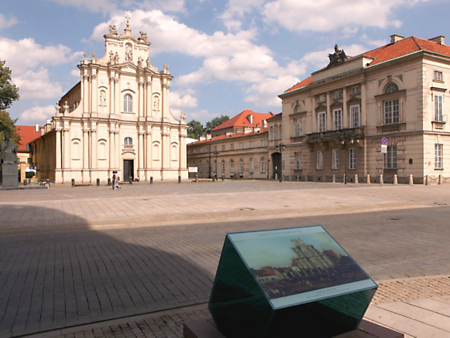
It was almost a miracle that Bellotto’s paintings made it into the twentieth century, never mind surviving World War II. The artist’s 22 street scenes had been removed from Warsaw’s Royal Castle on numerous occasions. Four canvases were taken by Napoleon’s officials in 1807. Russian Emperor Nicholas I seized the entire series in 1832. The Soviets requisitioned them “for safekeeping” in 1939. But when the paintings were confiscated by the Germans in 1940, it was assumed they were irretrievably lost or, far more likely, destroyed. Towards the end of the war, however, they were somehow tracked down by the American Art Protection Service (better known as the Monuments Men) and taken to the Central Collecting Point at Munich. In 1946 Polish authorities were able to reclaim them and they were returned to the collection of the National Museum in Warsaw—virtually unscathed.
Why was rebuilding Warsaw so important, anyway?
Of course, lots of European cities suffered damage and destruction during World War II. But those were the result of bombing campaigns or damage during active battles. The destruction of Warsaw was very different.
When the war was winding down in 1944, Polish resistance fighters rose up to liberate their city from German control (this was the second Uprising in Warsaw; the September 1943 Jewish Uprising in the Warsaw ghetto was the first). With Soviet forces rapidly approaching from the east, the fighters were confident in beating back the Germans. But Stalin, assuming the Polish resistance would not support his upcoming communist occupation, ordered his troops to remain outside the city. Without Russian troops to stop them, German forces were able to quash the uprising. Hitler—well aware that the Red Army would soon be in Warsaw and then into Germany itself—ordered the executions of any surviving Poles and the complete destruction of the city as punishment. So before beating a retreat back to Germany, demolition squads methodically moved from building to building and placed explosive charges. Just like that, structures that had stood for centuries collapsed and Warsaw was reduced to rubble—taking with it 700 years of Polish culture.
What’s new is old again
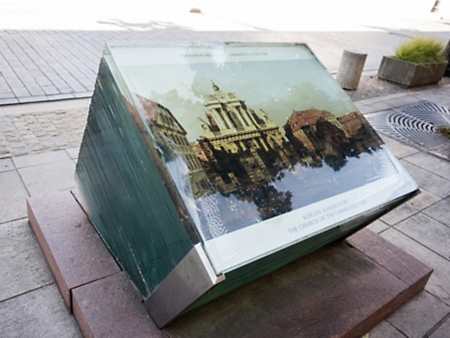
Bellotto’s paintings were used extensively in the reconstruction of Warsaw’s Old Town, with the majority of the work completed by 1955 (because it was a symbol of the monarchy in Poland, reconstruction of the Royal Castle would have to wait until the end of Russia’s occupation). Often out of necessity but sometimes due to a sense of nostalgia, rubble from the destroyed city was used to rebuild much of the new Warsaw—especially in the facades of the buildings in Old Town. While specialized builders did most of the actual reconstruction, local residents were instrumental in clearing the massive amounts of debris strewn across the city.
There is a general rule in the international community that says “preservation, not restoration.” A vanished landmark could be commemorated with a plaque, but it would be “inauthentic” to bring it back as a replica. Warsaw is an exception. Even UNESCO agrees on that point, making Warsaw’s Old Town a World Heritage Site in 1980 as an “outstanding example of near total reconstruction.”
It is difficult to believe that the work of a single artist could play such an important role in rebuilding any city, never mind a major capital like Warsaw. But it can be stated with certainty that without Bellotto’s paintings, Warsaw would look very different today.
More fascinating facts about the death and rebirth of Warsaw
Marvel at the reconstruction of Warsaw during O.A.T.’s New! Echoes of Poland: Royal Capitals to Baltic Shores adventure.
Expanding Horizons: Most Popular NEW Journeys by Land, Sea, and River
Discover our most popular new journeys with O.A.T. and Grand Circle.
From the Matterhorn to Mordor
What mountain range was the inspiration for the Misty Mountains in J.R.R. Tolkien’s The Lord of the Rings?
The Politics of Lithuanian Basketball
While exploring Lithuania, a travel blogger gained historical insights from a surprising source.
Get The Inside Scoop On...
Like what you see here? Receive weekly updates right in your inbox.
inside-scoopArticles In This Edition
